Mobilité
ONTRACK report
Proposals for a modal shift from air to rail for short journeys departing from Belgium
The aviation sector accounts for a growing share of greenhouse gas (GHG) emissions in Belgium and Europe. Unlike other sectors (industry, construction), its emissions continue to rise, even though they are mainly linked to “nice-to-have” uses (as opposed to “must-have” uses such as food, etc.). However, for a significant proportion of intra-European journeys, the train is already a credible, technically feasible alternative that is often more comfortable than air travel and emits much less GHG.
In the ONTRACK report, we quantified the emissions associated with intra-European flights from Belgium with equivalent train journey times of less than 15 hours, and assessed the potential CO₂eq savings of a modal shift to rail.
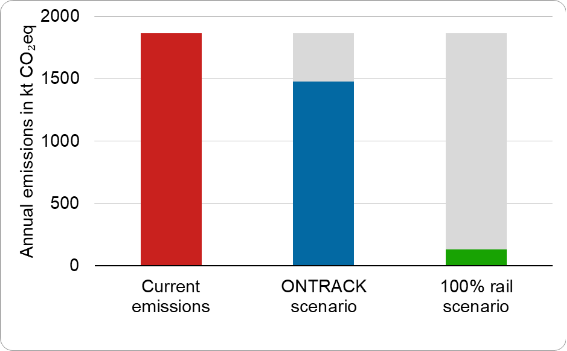
Figure: Emissions from flights with equivalent train journey times of less than 15 hours with no modal shift, ONTRACK modal shift, and 100% modal shift. Source: Shifters Belgium
In 2024, nearly 11.9 million passengers were transported on these journeys, for a total of approximately 1.8 million tonnes of CO₂eq emitted. If all these journeys had been made by train, the associated emissions would have been fourteen times lower, or around 132,000 tonnes of CO₂eq.
Applying realistic modal shift rates (100% for journeys of less than 4 hours train equivalent, 40% for journeys of 4 to 8 hours train equivalent, 10% for journeys of 8 to 15 train-equivalent hours), the potential annual gain is estimated at 389,000 tonnes of CO₂eq, equivalent to the average annual carbon footprint of 29,000 Belgians.
In light of this finding, three main recommendations are made:
- Eliminate very short flights (‘short hop flights’) when an alternative exists, while strengthening train-airplane integration through smoother transfers or the implementation of automatic rebooking.
- Strengthen rail connections to the busiest European cities and simplify connections when they are unavoidable.
- Make rail competitive at European level by correcting existing fiscal imbalances between air and rail, for example by exempting rail from VAT or taxing kerosene.
These measures would help reduce the climate impact of the aviation sector, promote more comfortable and accessible mobility, and strengthen Belgium's energy independence.
Documents
Read the report ONTRACK (February 2026)